
Virgin Islands Archaeology Field School 2026

Virgin Gorda is the second most populace island in the British Virgin Islands (BVI) archipelago with a small community that takes great pride in a huge history. Once home to a thriving Amerindian population, the island was briefly occupied by the Spanish in the early sixteenth century who were mining copper, then abandoned until the late seventeenth century when planters and pardoned pirates began to settle. Small marginal cotton, tobacco, indigo, and sugar estates operated on Virgin Gorda and its satellite islands until the early nineteenth-century, when the plantation industry collapsed. A copper mine operated by Cornish miners provided limited economic respite in the mid-nineteenth century, until tourism emerged in the 1960’s and the island became a playground for the wealthy and famous.
The British Virgin Islands National Parks Trust in partnership with the Royal Agricultural University in Cirencester England, would like to invite you to participate in the 2026 Virgin Islands Archaeology Field School focusing on three protected national parks, each of which presents exciting and unique archaeological opportunities.
SITE 1
COPPER MINE POINT
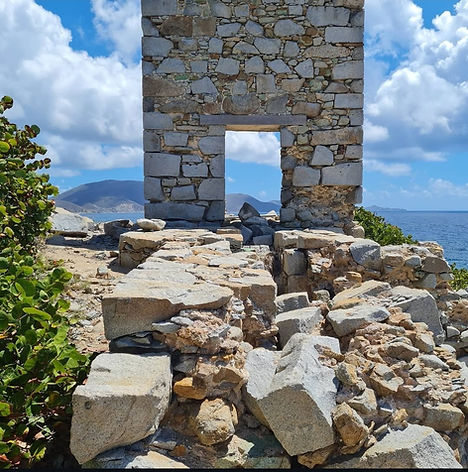
During the 1840’s and 1860’s, a copper mine identical to those operating along the Cornish coastline of England (made famous by the television series ‘Poldark’) was constructed on the south-east tip of Virgin Gorda. Entire families from Cornwall relocated to Virgin Gorda and with the local population operated a lucrative mine until production costs exceeded profit. The objective at this site is to survey the industrial facility, locate and record the settlement where the Cornish miners and their families resided, and record thoroughly the beam of the mine engine still abandoned on the shoreline with the intention of recovering the artefact for future preservation and display.

SITE 2
Fort George
During the eighteenth and early nineteenth-century European conflicts that spilled into the Caribbean, a network of fortifications was erected in the BVI designed to protect the colony from invasion. Fort George was the primary fortification on Virgin Gorda which protected the main anchorage of St. Thomas Bay and was possibly the site of a Spanish emplacement in the early sixteenth century. The objective for this site is to survey and drone map the eighteenth-century fortification and magazine, whilst also applying archaeological techniques to reveal any evidence of an early Spanish occupation.

SITE 3
Prickly Pear Cotton Plantation
This virgin site has never been disturbed apart from the occasional adventurous hiker and presents a unique opportunity to study a small island marginal plantation producing cotton and provision crops. Located on a small satellite island in an area known as North Sound adjacent to Virgin Gorda, the objective on Prickly Pear is to survey and drone map the remaining features; record, collect, identify, catalogue and document the multiple remaining surface artefacts, and pollen sample specific areas to identify where the cotton plantation was located on the island and what provision crops were being grown.
COPPER MINE POINT
SITE 1
During the 1840’s and 1860’s, a copper mine identical to those operating along the Cornish coastline of England (made famous by the television series ‘Poldark’) was constructed on the south-east tip of Virgin Gorda. Entire families from Cornwall relocated to Virgin Gorda and with the local population operated a lucrative mine until production costs exceeded profit. The objective at this site is to survey the industrial facility, locate and record the settlement where the Cornish miners and their families resided, and record thoroughly the beam of the mine engine still abandoned on the shoreline with the intention of recovering the artefact for future preservation and display.
Fort George
SITE 2
During the eighteenth and early nineteenth-century European conflicts that spilled into the Caribbean, a network of fortifications was erected in the BVI designed to protect the colony from invasion. Fort George was the primary fortification on Virgin Gorda which protected the main anchorage of St. Thomas Bay and was possibly the site of a Spanish emplacement in the early sixteenth century. The objective for this site is to survey and drone map the eighteenth-century fortification and magazine, whilst also applying archaeological techniques to reveal any evidence of an early Spanish occupation.
Prickly Pear Cotton Plantation
SITE 3
This virgin site has never been disturbed apart from the occasional adventurous hiker and presents a unique opportunity to study a small island marginal plantation producing cotton and provision crops. Located on a small satellite island in an area known as North Sound adjacent to Virgin Gorda, the objective on Prickly Pear is to survey and drone map the remaining features; record, collect, identify, catalogue and document the multiple remaining surface artefacts, and pollen sample specific areas to identify where the cotton plantation was located on the island and what provision crops were being grown.
Discover
Embark on a journey through our diverse landscapes, from lush rainforests to pristine beaches, and uncover the beauty of our national parks.

Field School Techniques Employed
-
Drone mapping
-
GIS surveying
-
Shovel and test pitting
-
Archaeological excavation
-
Artifact mapping and recovery
-
Pollen Sampling

Lab Work Techniques Employed
-
Archaeological technique and practice
-
Artefact cleaning, recording, and cataloguing
-
Ceramic sequence and identification
-
Site histories and previous studies
-
Virgin Gorda ecology and habitats
-
Virgin Islands archaeological past projects
-
Prof. Mark Horton-international archaeological projects

Academic Lectures
-
GIS data processing and interpretation
-
Drone map survey data processing and interpretation
-
Artefact cleaning, recording, cataloguing, and identification

Season dates 2026
29th June-12th July
Session Dates
30th June-11th July
Project Size
15 Participants
Deadline Type
Rolling
Application deadline
June 15th, 2026
REGISTERATION


